Hamlet and the Poetry of Emily Dickinson Student Book offers a rich exploration of the ways texts from different historical periods and literary traditions can be brought into conversation with one another. Designed to meet the requirements of the NSW Stage 6 English Advanced Year 12 Textual Conversations focus area, this resource helps students develop their understanding of how contexts, values, perspectives, and compositional choices shape meaning, and how reading texts alongside one another can generate new and transformative interpretations of both.
Through contextual investigation, close reading, guided comparative analysis, thinking routines, and explicit writing instruction, students examine the resonances and dissonances between William Shakespeare’s Hamlet and Emily Dickinson’s prescribed poetry. Particular attention is given to how Dickinson’s poetry reframes, extends, and challenges Shakespeare’s exploration of human consciousness, mortality, grief, suffering, identity, madness, truth, individual autonomy, and the tension between personal conviction and societal expectations.
Alongside Shakespeare’s Hamlet, the prescribed poems covered in this student book include:
21 ‘To learn the Transport by the Pain’
40 ‘I felt a Funeral, in my Brain’
58 ‘No Rack can torture me’
64 ‘Much Madness is divinest Sense’
67 ‘I died for Beauty – but was scarce’
96 ‘One need not be a Chamber – to be Haunted’
103 ‘Because I could not stop for Death’
149 ‘The show is not the show’
Across these texts, students explore the complexities of human consciousness, the limitations of reason and knowledge, the confrontation with death and the uncertainty of what lies beyond it, the relationship between suffering and insight, and the struggle to preserve intellectual and spiritual freedom. They also consider how the religious, philosophical, social, and cultural contexts of Early Modern England and nineteenth-century America inform each composer’s distinctive representation of these enduring concerns.
The study is complemented by imaginative, discursive, persuasive, reflective, and critical writing activities that encourage students to draw inspiration from the ideas and compositional choices of both writers. Comprehensive essay-writing instruction, practice essay questions, detailed scaffolds, and annotated model responses, underpinned by Into English’s Idea–Insight Writing Method, support students in developing compelling theses, insightful comparative analysis, and sustained, cohesive arguments.
Download the Table of Contents
Authors: Emily Bosco and Anthony Bosco
Format: PDF download, 149 pages
ISBN: 978 1 923140 48 6

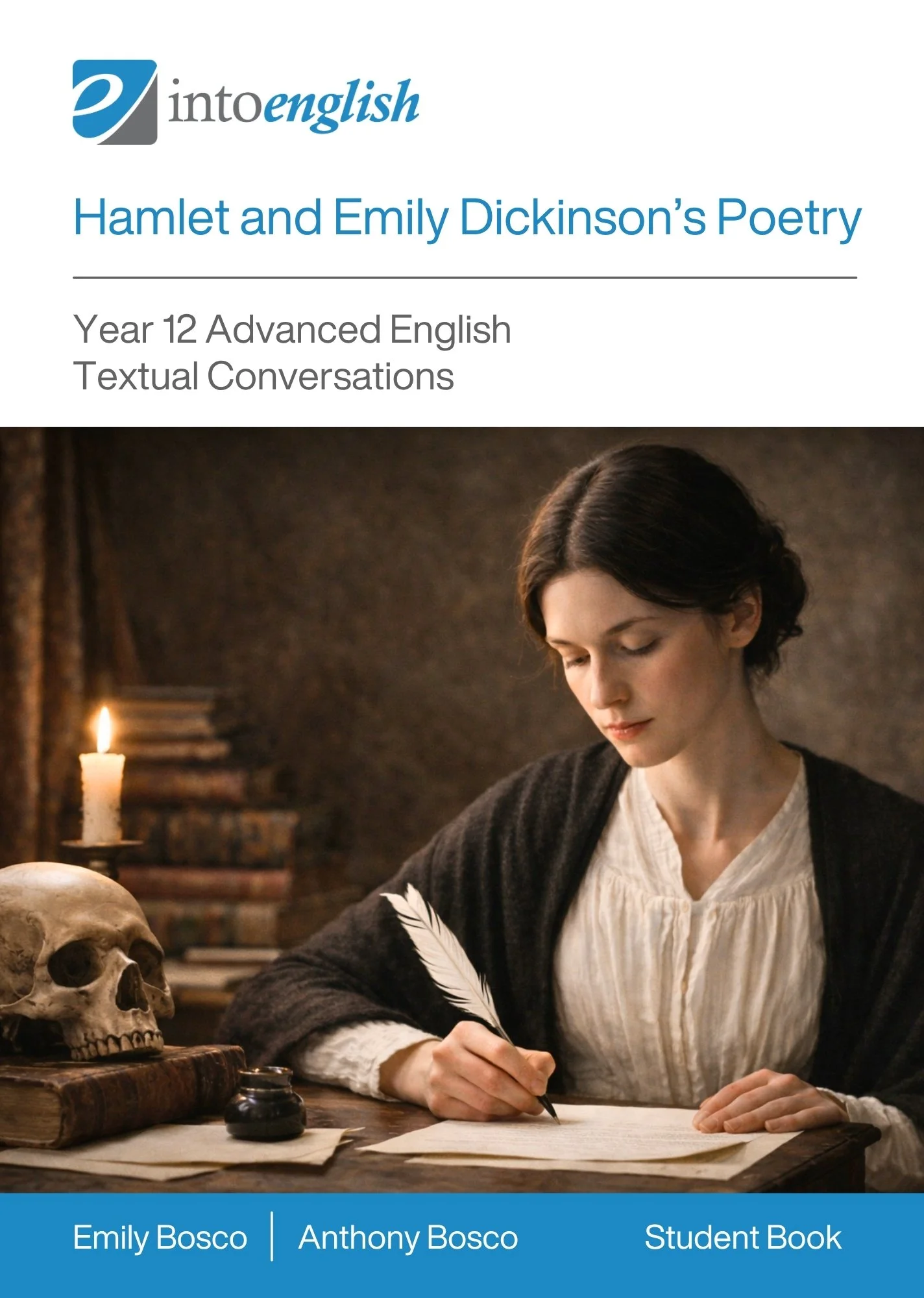 Image 1 of 1