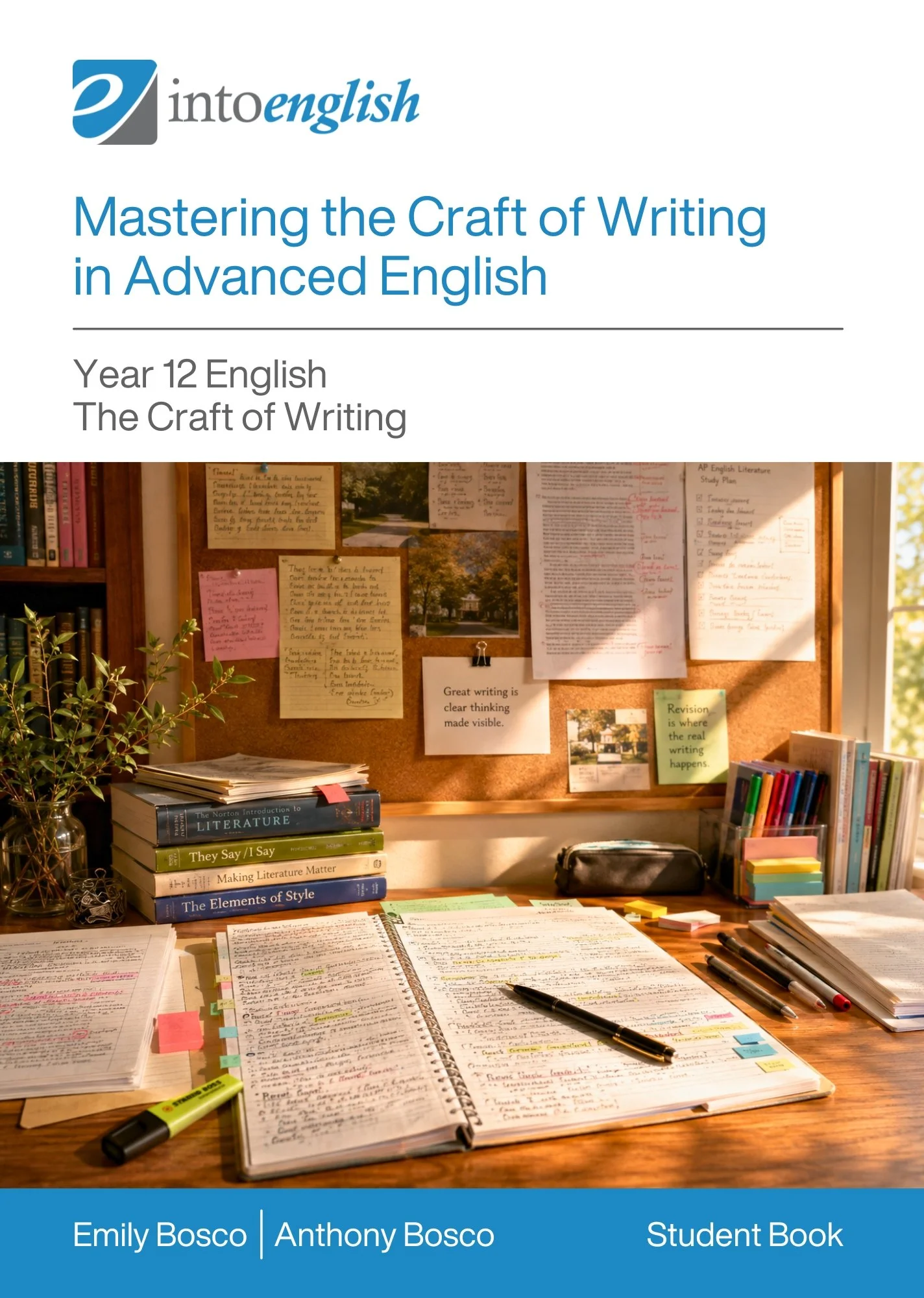
Our Mastering the Craft of Writing in Advanced English Student Book aims to deepen students’ understanding of writing as a craft and develop their confidence, control, precision, and versatility as writers of imaginative, discursive, persuasive, and reflective texts. It has been designed specifically to fulfil the requirements of The Craft of Writing focus area in the new NSW English Advanced 11–12 Syllabus (2024).
This student book encourages students to read as both critical readers and writers. Students explore how accomplished writers make purposeful and often complex choices about form, structure, language, voice, perspective, style, and textual features to develop ideas, evoke emotion, shape perspectives, challenge assumptions, and create distinctive aesthetic experiences. Rather than simply identifying techniques, students consider how authorial choices interact across a whole text and what they can learn from these choices for their own writing.
From there, students put this knowledge into practice. They experiment with craft choices such as narrative voice, perspective, imagery, motif, allusion, characterisation, rhetoric, dialogue, tone, structure, and syntax before combining these choices in sustained compositions of their own. Students are also encouraged to adapt, combine, and challenge conventions when this serves their purpose, audience, context, and ideas.
Activities guide students through the complete writing process:
reading → noticing → analysing → experimenting → composing → reflecting → refining
Eight carefully selected mentor texts form the centre of the student book: two imaginative, two discursive, two persuasive, and two reflective texts. Each has been chosen because it demonstrates distinctive possibilities for shaping complex ideas and experiences through language. Students examine significant authorial choices, evaluate how those choices work together, and then adapt the underlying craft principles in original writing of their own.
The mentor texts covered in this student book are:
‘Cell One’ by Chimamanda Ngozi Adichie
‘Everyday Use’ by Alice Walker
‘Joy’ by Zadie Smith
‘Recovering a Narrative of Place: Stories in the Time of Climate Change’ by Tony Birch
‘Nobel Prize Acceptance Speech’ by William Faulkner
‘The Work You Do, The Person You Are’ by Toni Morrison
‘An Ogmore Story’ by Melinda Mann
‘Once More to the Lake’ by E. B. White
With its combination of close mentor-text study, explicit craft instruction, experimentation, sustained composition, reflection, exam-style practice, and model responses, Mastering the Craft of Writing in Advanced English helps students develop the flexible and sophisticated repertoire of skills needed to respond confidently to school-based assessment tasks and the HSC examination.
Download the Table of Contents
Authors: Emily Bosco and Anthony Bosco
Format: PDF download, 200 pages
ISBN: 978 1 923140 44 8








The Poetry of Gwen Harwood Student Book offers a rich exploration of the ways texts represent individual and collective human experiences. Designed to meet the requirements of the NSW Stage 6 English Year 12 Texts and Human Experiences focus area, this resource helps students deepen their understanding of how composers use language, form, structure, imagery, and voice to represent experiences of identity, relationships, acceptance, growth, and change, and how texts can challenge assumptions and invite us to see the world differently.
Through close reading, guided analysis, thinking routines, and explicit writing instruction, students examine how Gwen Harwood’s poetry represents experiences of childhood, memory, family, love, vulnerability, ageing, grief, mortality, creativity, embodiment, and the limits of language. Particular attention is given to the connections across the prescribed poems, helping students recognise how recurring ideas, images, and experiences create a cohesive and richly interconnected poetic suite.
The prescribed poems covered in this student book include:
‘The Glass Jar’
‘The Violets’
‘At Mornington’
‘Father and Child, I and II’
‘A Valediction’
‘Beyond Metaphor’
‘The Sharpness of Death’
Across these poems, students explore the movement from childhood innocence towards knowledge, the ways memory reshapes the past, changing relationships between parents and children, the vulnerability and sustaining power of love, and the human confrontation with ageing, loss, and mortality. They also consider Harwood’s recurring use of light and darkness, flowers, water, music, nature, the body, and sensory experience to connect deeply personal moments with broader insights into human experience.
The study is complemented by carefully selected related texts and writing activities that broaden students’ perspectives and strengthen their capacity to analyse, interpret, evaluate, and compose.
Download the Table of Contents
Authors: Emily Bosco and Anthony Bosco
Format: PDF download, 149 pages
ISBN: 978 1 923140 46 2